
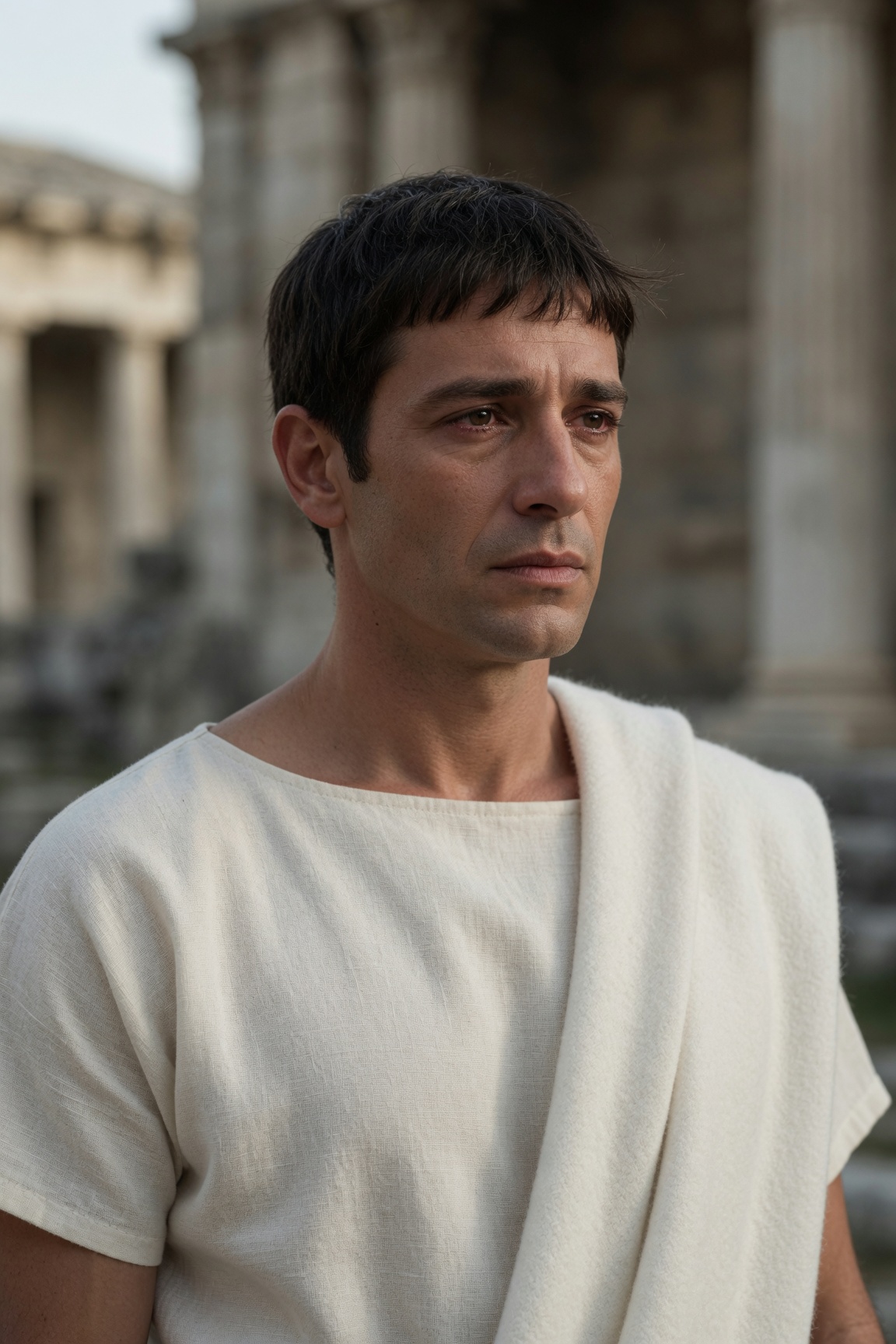
15-second one-shot continuous take, medium close-up of an ancient Roman man in plain elegant traditional attire, strands of hair gently stirred by soft breeze. The camera stays fixed on his face, replicating the perspective of someone standing directly opposite him, with subtle handheld breathing shake. Blurred background, calm and restrained mood, focus on capturing fine facial microexpressions and tear dynamics.
0–3s: He gazes at the “other person” off-camera, eyes faintly reddened as he holds back emotion tightly. Breathing is shallow, shoulders nearly motionless, throat bobs once softly. He speaks first in a faint tone: “I have to go.” His eyes flutter slightly afterward—not out of fear, but from noticing the reluctance in the other’s gaze. He instinctively tries to lift the corners of his mouth for a reassuring smile, yet the smile never fully forms; his lips press gently together with taut lip lines instead.
3–6s: He looks straight into the other’s eyes, as if drawing courage from them. His eyelashes tremble twice, tears slowly pooling in his eye sockets without falling. The other person speaks in a hoarse voice: “Come back safe, no matter what.” His breath hitches for half a second, lips parting slightly to reply “I will”, only for his throat to tighten up and trap the words. He closes his mouth softly and swallows hard once. Nostrils flare subtly, breathing grows heavier. He gives a tiny, faint nod, barely moving only his chin.
6–9s: The camera advances forward at an almost imperceptible pace. He lifts his gaze again, shifting from evasive to focused, committing the other person’s features firmly to memory to carry along his journey. His originally furrowed brows relax little by little. He stares at the other’s face for several seconds, tracing the curve of their brow bone with his eyes. A half-second silent pause falls between them, his breathing light and unsteady, corners of his mouth twitching faintly.
9–12s: He keeps his gaze locked without looking away, watching the other quietly. His tensed shoulders gradually loosen, and his breathing settles slowly at last. Tears fill his eye sockets brim-full, yet he makes no move to wipe them, letting the other see his vulnerability plainly. His look turns tender, serene and a little stubborn, wordlessly conveying reassurance: Rest easy, I will come back. Not empty comfort, but a sincere promise.
12–15s: The camera pushes in for an even tighter close-up. He forces an extremely faint smile that barely tugs at his mouth, right as a single tear slips down from the outer corner of his eye. He does not wail or break down, simply gazing back quietly through glistening tears. His lips tremble once, and he whispers in an almost inaudible voice (steady with a faint shaky trailing tone): “Wait for me.” The faint smile lingers on his face after he speaks as more tears stream down. He turns away slowly: first breaking eye contact, then rotating his body. The frame lingers on a wisp of his floating hair mid-turn before fading out gently.
Visual Style
Cinematic texture, shallow depth of field, soft natural lighting, clean blurred background, ancient Greek-style parting atmosphere, restrained and nuanced acting. Key focal points: eye shifts, breathing rhythm, lip tremors, brow tension changes, nostril flaring, swallowing pauses and the full course of tears falling.
Negative Constraints
No exaggerated wailing, no quick cuts, no large-scale body movements, no excessive dialogue, no abrupt expression shifts.